The starting point
Projection mapping describes how imagery is aligned with a surface. Interactive art describes how people influence a work. They can overlap, but neither implies the other: a building projection may be a timed story, while an interactive work may respond through projection, sound or another medium.
Begin with the audience’s role
Do you want people to gather and experience a story together, or to change what happens through their own action? Both can be valuable. A shared screening can establish a common rhythm across a crowd. A responsive artwork can give one person a recognisable role within a public event. Choose the role first, then consider the media that could support it.
When architecture carries the narrative
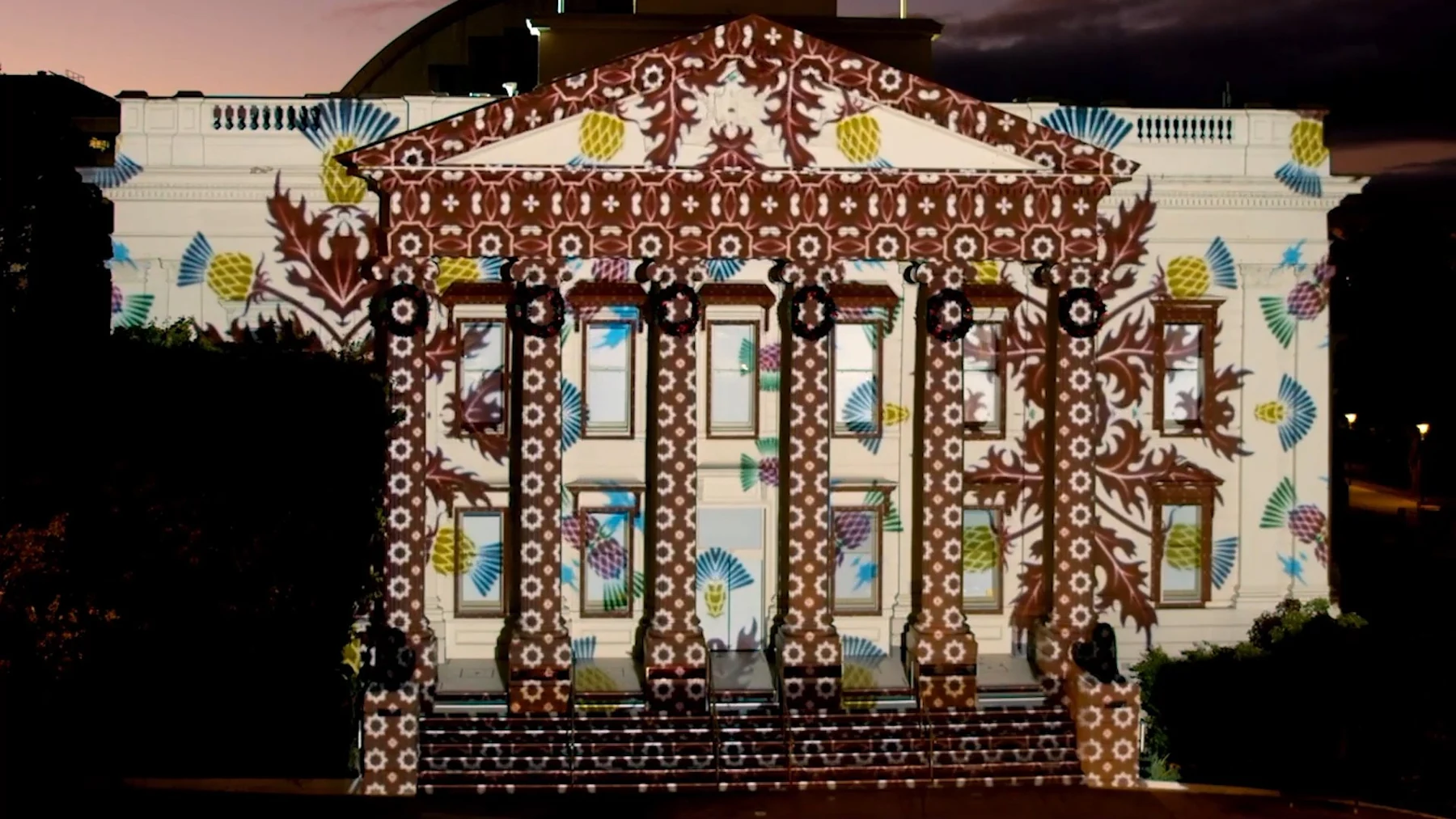
Georgie’s Geelong work uses a civic facade as part of an audiovisual composition. The building appears to unwrap, revealing animated layers alongside original music. The experience is authored around a place and a narrative. It should not be described as audience-controlled simply because projection technology is involved.
When a participant changes the work
In ECHO/OHCE, faces become material for a large projected portrait. Electric Puppet lets people make a character and animate it through movement. In these formats, the input and response are central to the artwork. The invitation needs to be understandable, with enough space and support for people to encounter it on their own terms.
When the two approaches meet
A projection-mapped sculpture can respond to a participant. A building story can sit beside a separate interactive activity. Combining them should serve a clear purpose rather than add technology for its own sake. Ask whether the audience should watch, make, perform or move between those roles, and how each transition will be explained.
Compare the operational implications
For a timed audiovisual work, consider screening intervals, sightlines, sound and how people arrive and leave. For an individual interaction, also consider capacity, waiting, facilitation and alternative ways to take part. A busy public location may need a different interaction from a quiet exhibition. These questions help identify what needs testing before a full presentation.
Match evaluation to the chosen experience
For a projection narrative, you might explore audience understanding, recall and the viewing experience. For a responsive installation, you may also observe completed interactions and whether people understand their influence. Neither format automatically proves increased spending, learning or belonging. Define the intended outcome and collect appropriate evidence.
Use examples to start the conversation
Share a project whose relationship with its audience interests you. Describe what you would keep and what your site requires differently. The projection-mapping and interactive-public-art pages explain the two practices, and the case-study collection shows how they operate in different contexts. You do not need to arrive with a fixed technical specification.
Projects mentioned
Prepare your brief
Use the public briefing checklist, explore interactive public art or projection mapping, then request a concept call.